Denmark and Taiwan Cooperate on Wind Power
The Director of Denmark’s Trade Office in Taiwan, Nicholas Enerson, led a delegation to Changhua County [Chinese Language] this week, to view and discuss the development of wind farms in the county.
A delegation from Denmark meets with Changhua County Magistrate Wei Ming-ku (魏明谷) November 24, 2016. Photo: Changhua County Government.
On Thursday, November 24, the Danish delegation met with County Magistrate Wei Ming-ku (魏明谷), who said the meeting was a milestone in Taiwan-Denmark exchanges. Mr Enerson expressed Denmark’s willingness to invest in Changhua County’s green energy industries.
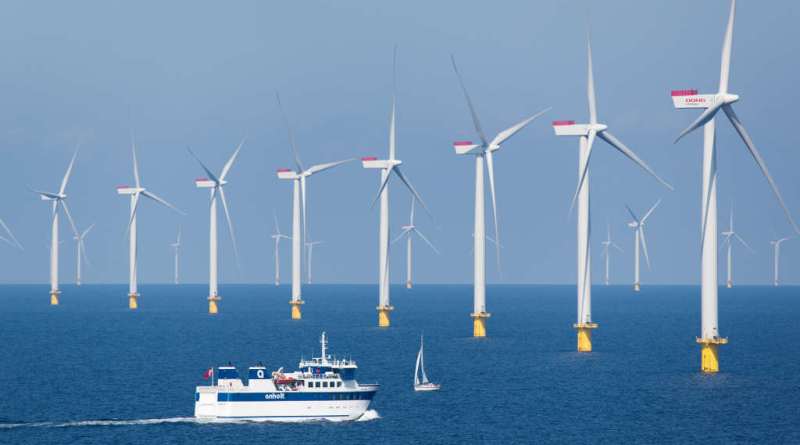
Taiwan and Denmark will cooperate to develop world-class offshore wind farms using state-of-the-art technology.
Taiwan’s Ministry for Economic Affairs Energy Bureau has identified 21 sites suitable for offshore wind power in Changhua County, and Denmark’s DONG Energy is carrying out environmental impact assessments on four of the sites.
Once EIAs have been passed, and investments are approved by the board of directors, the Danish power company hopes to develop a generating capacity of more than 2GW on the sites.
Samuel Leupold , CEO of DONG Energy Wind Power, Dr Robert Hu, ITRI and Matthias Bausenwein, DONG Energy Asia-Pacific General Manager at the inauguration of DONG Energy’s Taipei Office, November 16, 2016. Photo: Dong Energy.
At the inauguration of its Taiwan office earlier this month, DONG Energy’s General Manager for Asia Pacific, Matthias Bausenwein said: “Building on our 25 years of experience with offshore wind, I believe we can help Taiwan make the most of its tremendous offshore wind resources. Offshore wind can become a key component in Taiwan’s future energy mix, and provide a stable, utility-scale, and green source of power from the strong winds in the Taiwan Strait.”
Dong Energy officially opened its Taiwan office November 16. The company has a current wind-powered capacity of 3GW, mostly in northern Europe, and currently has 7 wind farms under construction with an expected 4.4GW generating capacity. Last month, the company became the first to complete construction of its 1000th offshore wind turbine.
At Thursday’s meeting, County Magistrate Wei said that in addition to power-generation, Changhua County wants to tap into Denmark’s expertise in green energy applications such as electric buses, and other carbon-reducing technologies.
This year, Denmark ranked #1 in the World Energy Council’s Energy Sustainability Report. Denmark also produced a world-record 42.1% of its total energy consumption using wind turbines in 2015, after breaking the record the previous year with 39.1%.
2015: 42.1%
2014: 39.1%
2013: 32.7%
2012: 30.0%
2011: 28.3%
2010: 22.0%
2009: 19.4%
2008: 19.3%
2007: 19.9%
2006: 17.0%
2005: 18.7%
Denmark has expressed an interest in sharing the nation’s expertise with Taiwan for a long time. Documents published on the Trade Office website [Danish Language] in 2011 show that Danish companies recognized the great potential of wind power in Taiwan, and saw the country as a potential springboard into the Asia-Pacific market, including Korea, China, Japan, and the Philippines.
President Tsai Ing-wen’s (蔡英文) Democratic People’s Party administration came to power this year with a nuclear-free homeland energy policy. The DPP government wants to see Taiwan’s three nuclear power plants shut down by 2025.
Tsai has promised that her administration will increase Taiwan’s green energy production to 50 billion kilowatt-hours within the next 10 years, but critics say this is unrealistic.
Related Article: Gas Station Rooftops Become Solar Farms
This summer, Taipower’s operating reserve fell to a critical level of just 1.64%, and through the fall and winter is expected to hover around 3-4%. A stable power supply usually requires at least a 10% operating reserve.
Currently, Taiwan depends on imports for 98% of its energy production needs. The country is home to the world’s largest coal-powered power plant, in Taichung County, which is also known as the world’s biggest emitter of carbon dioxide, at 36,336,000 tons of CO2 per year.